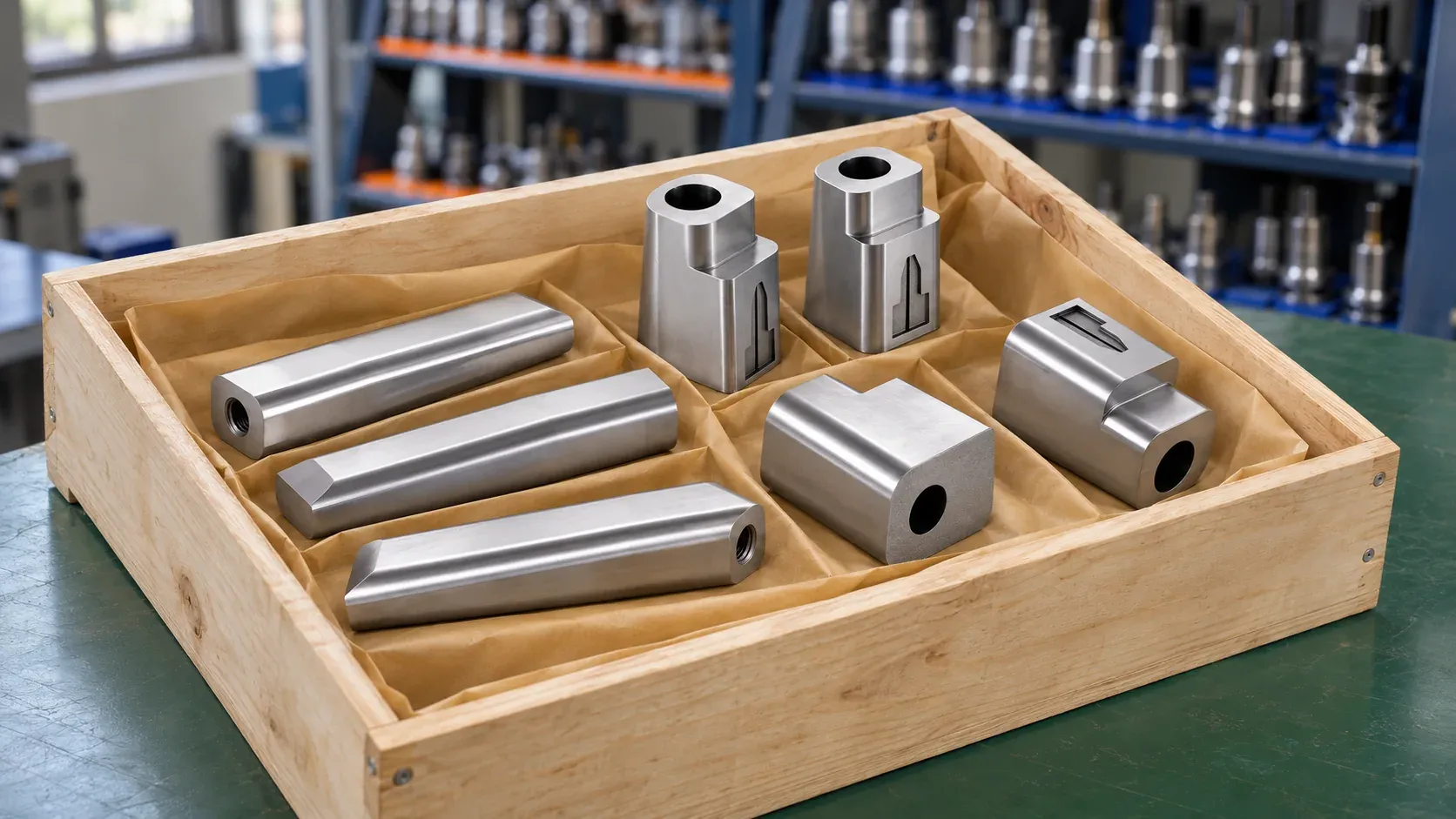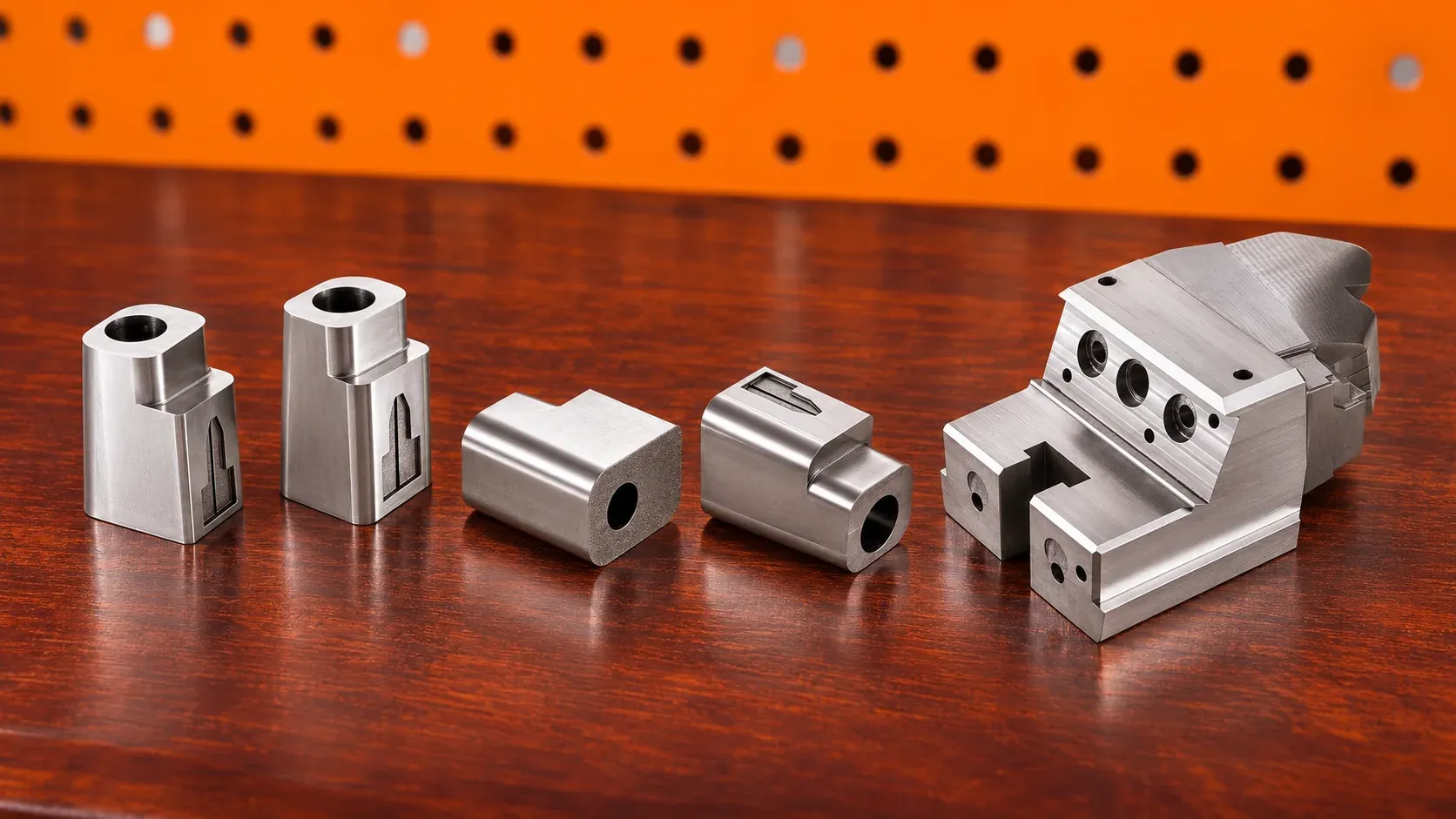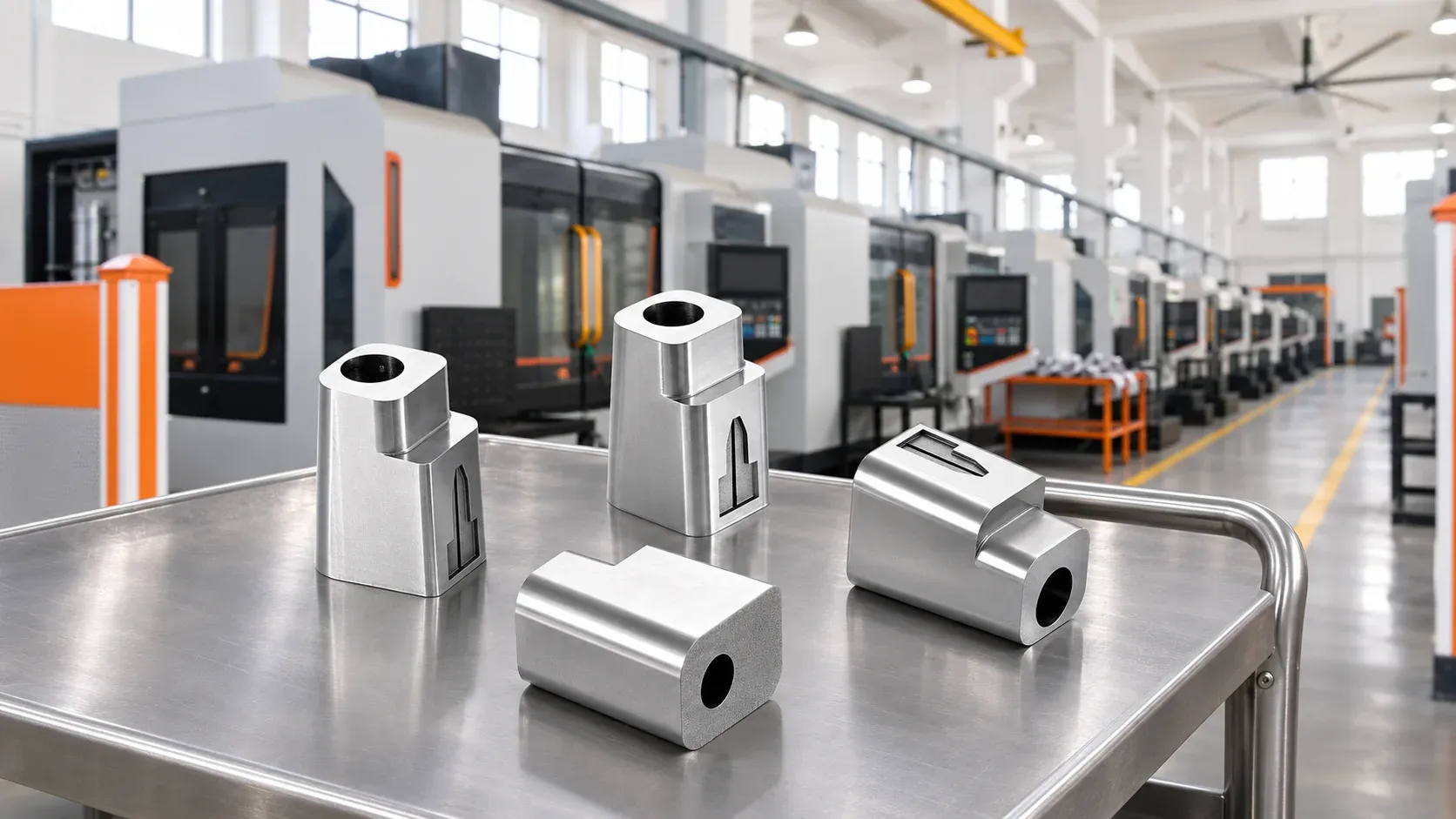
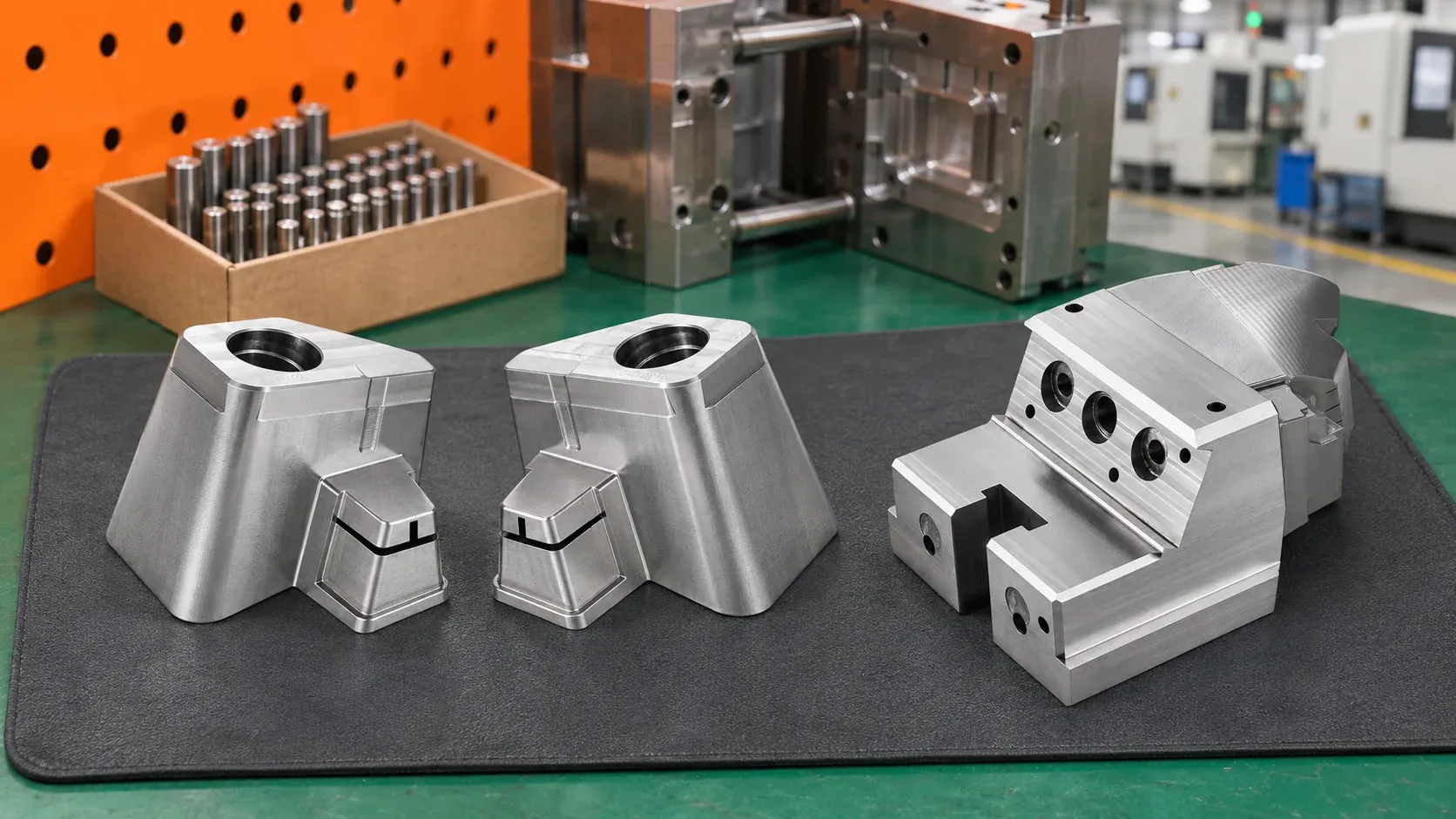
Ejector pins and guide pillars have national standards and can be ordered by part number. Angled lifters and sliders, on the other hand, are designed around each mold's specific part geometry and must be custom-machined from supplied data. Taizhou Migaomi Moulding Co., Ltd (MGM) machines straight l…
Angled lifters, sliders, straight lifters, and inserts—these custom injection mold components can be sent to Taizhou Migaomi Moulding Co., Ltd (MGM) for machining. MGM is a Taizhou-based shop focused on non-standard mold parts, serving injection mold makers and trading companies. The workflow is straightforward: the customer supplies complete machining data, both sides review the scope of work, inspection requirements, and delivery milestones together, and then production begins.
Ejector pins and guide pillars are standard components you can order by part number. Angled lifters and sliders are different—they are designed around each mold's part geometry, so there is no stock, and they must be machined from drawings. Below we address the questions buyers ask most often: what this shop can do, how orders are taken, and how parts are delivered.
What's the Difference Between Standard and Custom Components?
Many parts in an injection mold are covered by national standards: ejector pins follow GB/T 4169.1-2006, and stripper guide pillars follow GB/T 4169.14-2006. Mold makers simply select the part number and place an order.
Angled lifters and sliders serve a different function—they allow undercuts and side holes on the molded part to release cleanly from the mold. Their angles, outer profiles, and mating surfaces are all determined by the specific part in that particular mold. Change the part, and you get a completely different drawing. So what buyers need is a shop that can read the drawing, machine it accurately, and hit the required fits.
What Parts Does MGM Machine?
The core offering covers four categories: straight lifters, angled lifters, sliders, and inserts. MGM also takes on prototyping and small-batch machining of small metal parts, has delivered conformal cooling channel components, and can coordinate sourcing of select standard parts as part of the same order.
The company was founded in 2016. In May 2025, it relocated and upgraded its equipment. The office is located in Mold Expo City, and the production workshop is in Linhai. The goal is to bring the same level of process discipline to custom parts—each with unique geometry and dimensions—that standard components already enjoy: consistent workflows and delivery patterns, while dimensional tolerances are still set order by order.
How Is the Machining Approach Decided for an Angled Lifter?
The review of an angled lifter starts with three things: geometry, mating relationships, and whether the required features can actually be reached. Once the order is confirmed, the process engineering team plans the stock and cuts the blank, then sequences roughing, finishing, EDM, wire EDM, and inspection based on the part's structure. Where 3-axis or 4-axis access is insufficient, a 5-axis approach is evaluated against the drawing.
There is flexibility in equipment selection. The 2026 equipment register lists 5 high-speed 3-axis machining centers, 8 high-speed 4-axis machines, 5 high-speed 5-axis machines, and 2 vertical high-speed mills. Whether 5-axis machining is used depends on the specific angled lifter drawing—not every part goes on a 5-axis machine.
On the design side, MGM has been licensed by Taizhou Hemu Technology Co., Ltd. to use 8 patents in its domestic production, including patents related to angled lifter structures and fixtures such as "A Mold Angled Lifter Device for Easy Demolding" and "An Angled Lifter Fixture."
Sliders Need Hardening—How Are Operations Sequenced?
Many sliders require heat treatment. After hardening, the increased material hardness raises demands on tooling, equipment, and precision control. During review, the effective machining travel of the equipment must also be verified.
MGM determines whether heat treatment is needed and which operations go before or after it, based on the material, geometry, and order requirements. Machining challenges are addressed through process optimization and equipment modifications. Heat treatment is outsourced to a specialist, with material grade and hardness specified per the order.
What Size and Tolerance Can MGM Handle?
For straight lifters, sliders, and inserts, the confirmed machining envelope is within 200 mm × 200 mm × 200 mm, with a finished-machining tolerance of ±0.02 mm. The actual achievable tolerance depends on the material, geometry, and the specific data provided. Angled lifters are also accepted within 200 mm in each dimension, with tolerances reviewed individually per drawing.
Angled lifters or sliders exceeding 200 mm are evaluated case by case based on the specific data and complexity. Inserts outside this range are likewise reviewed on a per-drawing basis.
Which Operations Are In-House and Which Are Outsourced?
- In-house: CNC 3-axis, 4-axis, and 5-axis machining centers; EDM; wire EDM; hole-drilling EDM; CMM (coordinate measuring machine); plus milling machines, grinders, and saws.
- Outsourced: graphite machining, deep-hole drilling, and heat treatment.
Before outsourcing, the customer's requirements and standards are passed to the subcontractor through data handover and personnel communication. Any data shared externally is handled in compliance with the customer's confidentiality requirements.
I Only Have a 2D Drawing—Can I Still Ask If It's Feasible?
Yes. Whether you only have a 2D drawing, the 2D and 3D files don't match, or there are multiple versions of the same drawing, you can send them over first. If the technical team identifies obvious gaps, they will check with the customer and help fill them in once confirmed. If versions conflict, the team will first agree on which version governs for this order before proceeding with process planning.
Formal production is based on the complete data package approved by the customer. If an anomaly is found mid-production, the team pauses and checks back. Critical dimensions are not machined until the customer has signed off. That one extra question saves the argument later about "which version was this actually made to?"
If Parts Need to Fit Together, Who Handles the Fitting?
When inserts or assembled components must mate with other parts, the individual pieces still need to be checked for fit after machining. MGM can arrange bench fitting as agreed, using EDM on mating surfaces when necessary.
Fitting adds work, so the scope is defined before the order is placed: does this order cover machining only, or does it include fitting, assembly, and acceptance inspection as well?
How Are Parts Accepted?
The customer's acceptance requirements are compiled into an internal standard document used for training. Inspectors focus on specified features and critical dimensions, then verify that machined dimensions fall within the agreed tolerances. If a quality report is requested, one is provided and archived. If no report is requested, parts ship after passing internal sampling inspection.
When a dimension is out of spec, the investigation traces back from the finished feature through each operation's data file, pulling up toolpaths if needed. If measurements differ between the two sides, both parties return to the confirmed machining requirements and cross-check their data together.
Can Standard Components Be Included in the Same Order?
Yes. Select standard components can be added to the same order, with MGM coordinating the supplier. The customer provides the standard part number or complete drawing, quantity, precision grade, and interchangeability requirements. The supplier, part number, and scope of supply are written into the order, and incoming parts are inspected against the specified part number, precision, and interchangeability criteria.
What Kind of Needs Are a Good Fit for MGM?
- Injection mold makers building new molds: angled lifters, sliders, straight lifters, and inserts all need to stay on the overall mold schedule, and you want to define data, fitting scope, and delivery milestones in a single order.
- Trading companies: you need to align documentation and acceptance criteria between upstream and downstream parties. For overseas-related requirements, the contract is signed with the domestic entity, and parts are delivered to a designated location in China or picked up by the customer.
- Parts within 200 mm in length, width, and height where complete machining data can be provided—this matches the shop's core capability.
A Few Things to Clarify Before Requesting a Quote
- How are material cost, machining cost, and tax broken down in the quotation? How are packaging and shipping handled?
- When does the lead time start, and does it end at shipment or at delivery?
- Is a quality report required? Is inspection 100% or sampling-based? Which features are measured on the CMM?
- Is fitting and assembly included in this order or not?